

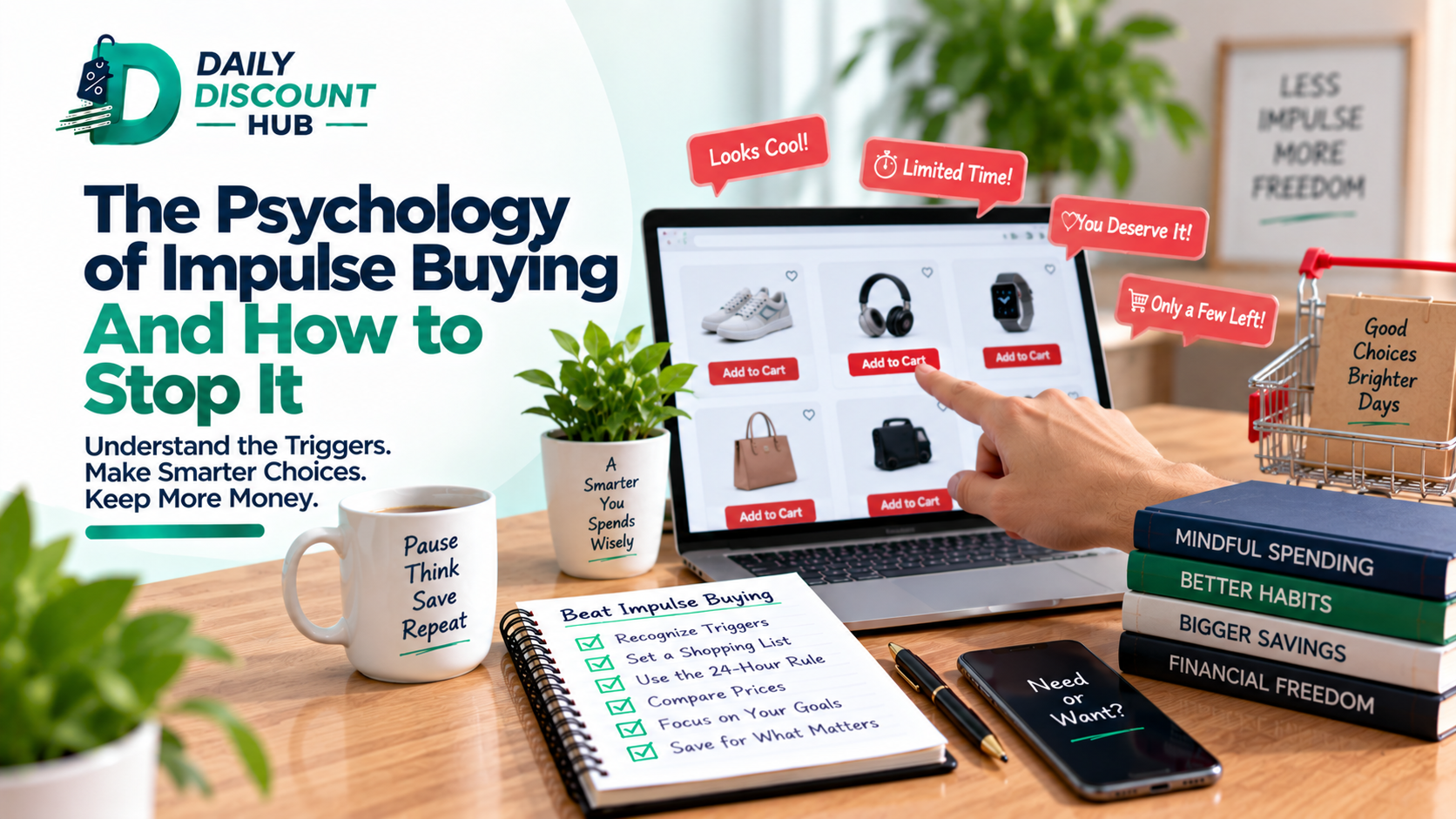
You opened an app to check one thing. Fifteen minutes later you've bought something you didn't plan to, don't urgently need, and will probably feel ambivalent about tomorrow. It wasn't a lack of discipline. It was a system working exactly as designed.
Impulse buying isn't a personal failing - it's a predictable response to specific psychological triggers that modern e-commerce has become exceptionally good at activating. Understanding why it happens is the first step to interrupting it. And having the right tools in place means you don't have to rely on willpower alone.
Check whether a deal offers genuine value or is simply a marketing trick before making your purchase.
Impulse buying is any unplanned purchase made in the moment, driven by emotion rather than deliberate need. It's always existed in retail - candy at checkout counters, sale bins at store entrances - but digital shopping has made it dramatically easier and more frequent.
One-click checkout removes friction. Personalized recommendations surface products you didn't know you wanted. Push notifications create artificial buying moments throughout the day. Apps are designed to minimize the gap between desire and purchase, because every second of delay increases the chance you reconsider.
The result is that impulse buying has expanded far beyond occasional treats into a significant source of financial leakage for most households - one that rarely shows up clearly in any budget because each individual purchase feels small and reasonable in the moment.
This becomes even easier to understand when you look at why discounts are so hard to resist and how urgency, scarcity, and reward cues can influence purchasing decisions.
Emily researches pricing trends, product comparisons, discount structures, and consumer purchasing behavior. Her articles help shoppers identify genuine value and avoid misleading promotions.
The most common driver of impulse buying isn’t excitement – it’s stress. Retail therapy is a real psychological phenomenon: buying something provides a brief sense of control and pleasure during periods of anxiety or low mood. The purchase feels like a reward, a treat, or a small act of self-care. The financial consequence arrives later, after the emotional relief has passed.
Dopamine plays a central role. The brain releases dopamine not just when you receive something you want, but during the anticipation of getting it. Adding something to a cart, seeing it in a sale, imagining owning it – the reward response begins before any money changes hands. By the time you’re at checkout, the brain has already partially experienced the reward.
Scarcity effect – “Only 2 left” creates loss aversion. Missing the deal feels worse than the satisfaction of getting it feels good, so you act before you’ve evaluated clearly.
Anchor pricing – A high crossed-out original price makes the sale price feel like a bargain, triggering a “this is a smart decision” feeling that bypasses rational evaluation.
FOMO – Limited-time offers reframe not buying as losing something. The decision shifts from “do I want this?” to “can I afford to miss this?” – a very different cognitive frame.
Instant reward bias – The brain systematically overvalues immediate gains relative to future ones. A $60 purchase feels real now; the $60 that didn’t go toward your savings goal feels abstract and distant.
Individual impulse purchases feel minor. Collectively, they represent significant financial leakage.
A shopper who makes three unplanned $25–$50 purchases per month is spending $900–$1,800 annually on things that weren't on any list. Over five years, at even modest investment returns, that's a meaningful sum that never reached any financial goal.
The psychological cost compounds the financial one. Post-purchase regret, the low-level guilt of buying things you didn't need, and the vague sense that money is "disappearing" despite your efforts to be careful - these are the downstream effects of habitual impulse spending that most budgeting advice never addresses.
Traditional budgeting is reactive. You record what you spent last month and try to do better next month. But impulse buying happens in seconds, at emotional peaks, in exactly the moments when self-control is hardest to access.
Telling yourself "I'll be more disciplined" doesn't change the trigger conditions. The app still sends the notification. The timer still counts down. The dopamine response still fires when you see the sale badge. Willpower is a limited resource - it depletes throughout the day and is least available precisely when emotional spending is most tempting.
For people who need a more structured reset, learning how to stick to a no-spend challenge can provide a defined period for breaking habitual spending patterns and identifying which purchases are genuinely necessary.
What works instead is changing the conditions around the decision introducing friction, delay, and information at the moment of purchase rather than reviewing the damage afterward.
A practical starting point is to build a budget that curbs impulse spending, so discretionary purchases have a defined place in your finances rather than being decided entirely in the moment.
The most effective tools don't track your spending after the fact - they insert a decision layer before checkout.
Price comparison tools replace the emotional "this feels like a deal" response with a factual check. Is this actually cheaper than elsewhere? Is the original price genuine? Two minutes of comparison converts an emotional reaction into an informed decision.
Before acting on the sale label, check if that deal is really worth it by comparing the final price with the product’s actual market value rather than relying on the advertised discount percentage.
Discount calculators show real savings in dollar terms rather than percentage labels. A "40% off" badge is emotionally compelling. Seeing that it saves $8 on a $20 item - and that the same item is $16 elsewhere without any promotion - is factually grounding.
Savings goal planners make the opportunity cost visible. "This $60 purchase delays your emergency fund goal by 12 days" is a concrete trade-off that abstract budgeting doesn't surface. When the future consequence has a specific number attached, the immediate purchase feels less automatic.
Price history trackers remove manufactured urgency. A product that's been "on sale" for three months isn't creating a real deadline. Seeing that history turns the countdown timer from a threat into irrelevant noise.
Behavioral research consistently shows that introducing any delay between impulse and action significantly reduces completion rates. A structured pause is more effective than willpower.
Before completing any unplanned purchase:
For more practical ways to reduce unnecessary spending and make better purchasing decisions, explore our money saving tips for additional strategies you can apply alongside this five-step pause.
A notification arrives: "Flash sale - 50% off wireless earbuds, 2 hours only."
Same notification. Different outcome. Not because of discipline - because the information changed the emotional context.
Impulse buying is a psychological response to specific triggers - stress, dopamine, scarcity framing, instant reward bias - that modern e-commerce is built to activate. Willpower alone is an unreliable defense because it's depleted precisely when emotional spending peaks.
The more durable solution is building a decision layer into your shopping process: tools that introduce factual information at the moment of purchase, make opportunity costs visible, and expose manufactured urgency for what it is. Not to prevent all spontaneous buying - but to ensure the purchases you make are ones you actually chose, rather than ones that chose you.



Enter any original price and a discount percentage to instantly see your final price, exact savings, and whether the deal is genuinely worth it.
Don't just see the % off — get a deal score from 1–10 and a clear verdict: Worth It, Average, or Bad Deal. Stop getting fooled by inflated "original" prices.
A combination of emotional triggers (stress, boredom, excitement) and retailer tactics (scarcity signals, countdown timers, anchor pricing) that compress decision time and activate the brain’s reward system before rational evaluation occurs.
Introduce a structured delay before checkout, verify that any discount is genuine, and use a savings planner to make the opportunity cost of the purchase concrete. Decision quality improves significantly when even five minutes separates impulse from action.
By inserting factual information – real price comparisons, price history, savings goal impact – at the moment of decision rather than afterward. Information doesn’t eliminate the emotional trigger, but it changes the context in which the decision gets made.
Repeated dopamine reward cycles, behavioral reinforcement from “successful” purchases, and the frictionless design of e-commerce platforms can create habitual shopping behavior that functions similarly to other reward-seeking loops. Recognizing the trigger pattern is the first step to interrupting it.
Selected For You
Join our free newsletter and receive smart deals, savings hacks, and new tools every week.

Free smart tools and trusted guides to help you save money on every purchase, every day.
Company
Explore Guides
Quick Links
© 2026 Daily Discount Hub. All rights reserved.