
June 13, 2026 5:17 am
How to Use a Shipping Cost Calculator to Plan Smarter E-Commerce Pricing Strategies
Learn how to use a shipping cost calculator to build smarter e-commerce pricing strategies that protect your profit margins. This guide shows how to accurately estimate shipping costs, compare carrier rates, and integrate real delivery data into your product pricing so you can avoid underpricing, reduce losses, and scale your online store more profitably.
- June 6, 2026
- nazneen
- 11:08 pm
- Online Shopping Guides
A shipping cost calculator is a tool that estimates delivery charges based on a combination of inputs: package weight, physical dimensions, destination zone, carrier, and service level. The output is a per-order shipping cost estimate – the actual amount a carrier will charge you to fulfil that specific order.
For e-commerce businesses, this matters because shipping is not a fixed cost. It varies with every order, every customer location, and every carrier rate adjustment. Businesses that don’t calculate shipping accurately before setting prices end up in one of two bad positions: they underprice and absorb silent losses on every order, or they overprice and lose customers to competitors who’ve done the numbers more carefully.
The most common mistake is treating shipping as something to figure out at checkout. By that point, your price is already set and your margin is already committed. The right approach is to use shipping cost data at the beginning of the pricing process – not the end.
How a Shipping Cost Calculator Works for Pricing Strategy
Most shipping calculators draw on four primary inputs to generate a cost estimate. Understanding each one makes you better at using the tool – and better at spotting errors in your current pricing assumptions.
| Input | Why It Matters | Common Mistake |
|---|---|---|
| Package Weight | Direct billing factor for all carriers; heavier costs more | Using product weight instead of packaged weight – packaging adds 0.5–2 lbs |
| Package Dimensions | Used to calculate dimensional (DIM) weight, which may exceed actual weight | Ignoring DIM weight entirely – causes systematic cost underestimation |
| Destination Zone | All carriers use zone-based pricing; Zone 8 can cost 3× more than Zone 2 | Using one average rate regardless of where customers are located |
| Carrier & Service Level | Ground, priority, express – each has a different rate structure | Defaulting to one carrier without comparing alternatives per order type |
The calculator takes these inputs and produces a per-order shipping cost estimate. For pricing strategy purposes, the most valuable output is not any single estimate – it’s the average shipping cost per order across a representative sample of your typical order mix. That average is what you embed into your pricing model.
Step-by-Step Guide to Using a Shipping Cost Calculator for Pricing Decisions
The following five steps turn raw calculator outputs into an actionable pricing strategy. Work through these for every new product before publishing a retail price.
Step 1 – Input Accurate Product Dimensions and Packaged Weight
Measure the product as it will actually be shipped – in its complete packaging, not the item alone. Include the box, void fill, and any inserts. This is the most commonly skipped step, and the most consequential. Using bare product weight instead of packaged weight systematically underestimates shipping costs by 20–40% on lightweight products. Weigh your five most common product configurations in their shipping packaging and keep a reference sheet.
Step 2 – Select Realistic Destination Zones
Don’t use your nearest zone as a baseline. Use the average zone across your actual customer geography. If you’re based on the East Coast but 40% of your customers are in the Midwest and West, your average is probably Zone 4-5, not Zone 2. Run calculations for each major zone, then weight the results by how frequently you ship to each one. This weighted average is the number that goes into your pricing model.
Step 3 – Compare Multiple Carrier Options
Run the same dimensions and weight through at least three carriers before settling on a pricing assumption. USPS Priority Mail flat rate is cheapest for dense, heavy items in small boxes. UPS and FedEx ground become more competitive on heavier packages for mid-range zones. Regional couriers often undercut both for local delivery. A 10-20% difference in carrier rate translates directly to 10-20% more or less pricing headroom – this comparison is worth the time.
Step 4 – Calculate Your Average Shipping Cost per Order
Run the calculator across 10-20 representative order scenarios covering different product mixes, destination zones, and order values. Calculate the arithmetic average. This is your baseline shipping cost assumption. For businesses with a wide product range, segment this calculation by product category – shipping costs can vary significantly between a 2 oz jewellery piece and a 5 lb home goods item, and blending them into a single average distorts both.
Step 5 – Integrate Shipping Costs into Product Pricing
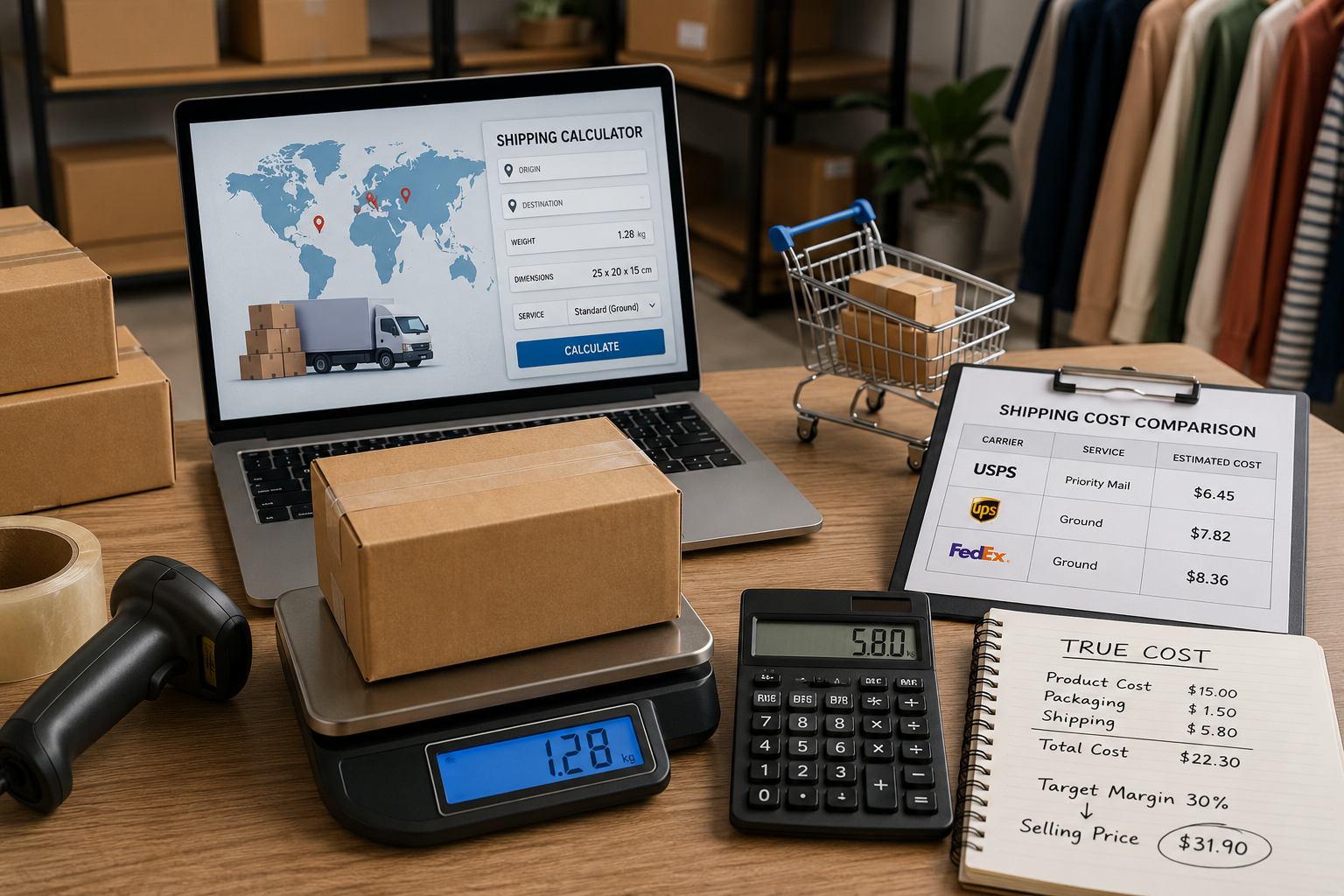
Add your average shipping cost to your landed cost before calculating margin. If your product costs $15, packaging costs $1.50, and average shipping costs $5.20, your true cost per order is $21.70 – and that’s the figure your margin percentage applies to, not the product cost alone. Businesses that miss this step consistently set prices that appear profitable on paper but erode in practice, order by order, carrier invoice by carrier invoice.
Discount Calculator
Enter any original price and a discount percentage to instantly see your final price, exact savings, and whether the deal is genuinely worth it.
How Shipping Cost Calculators Improve E-Commerce Profit Margins
The connection between shipping cost accuracy and margin improvement is direct and measurable. Here’s how it plays out in three common business scenarios.
Catching Dimensional Weight Before It Hits Your Invoice
A home goods retailer priced products with a shipping cost assumption of $6.50 per order based on actual weight. Running the same products through a DIM weight calculation revealed the true carrier charge was averaging $9.80 per order – a $3.30 difference. At 500 orders per month, that’s $1,650 in monthly margin loss that was invisible until modelled explicitly. Identifying this before launch allowed them to adjust retail prices by $4 across affected products before a single order shipped.
Dynamic Pricing Adjustments Based on Zone
An apparel brand noticed margin varied significantly by customer location without understanding why. A zone-by-zone shipping cost analysis revealed they were effectively losing 4% margin on West Coast orders versus East Coast orders due to higher zone rates – while charging all customers identical prices. A zone-based pricing tier adding $2-3 for higher-zone customers restored margin consistency across geographies without affecting conversion rates meaningfully.
Better Profit Forecasting for Peak Season
Shipping rates increase during peak season – carrier surcharges, fuel adjustments, and capacity fees can add $1-3 per package in Q4. Businesses that model these increases in advance using a shipping calculator can adjust pricing seasonally, absorb the increase from stronger Q4 volume, or negotiate carrier agreements locking in lower rates. Businesses that don’t model it discover the problem in January when reviewing Q4 margins.
Smart Pricing Strategies Using Shipping Cost Data
Once you have accurate shipping cost data, four established pricing approaches work for different business models. The right choice depends on your product margins, average order value, and customer expectations.
Strategy 1 – Flat-Rate Shipping Pricing
Absorb your average calculated shipping cost into the product price and offer free or flat-rate shipping. Works best when your product catalogue has consistent weight and size – the average shipping cost is predictable enough to embed reliably without systematically over- or under-recovering. If your average shipping cost is $5.80, add $6 to your product price and offer free standard shipping. Customers see a clean price; you’ve already built the cost in.
Strategy 2 – Zone-Based Pricing
Adjust product prices – or shipping charges at checkout – based on customer location and the corresponding delivery zone. Use calculator data to model the cost difference between your lowest and highest zones, then build a pricing tier that maintains consistent margins across all geographies. Most effective for businesses with high-margin products where a $2-4 regional price difference doesn’t affect conversion rates significantly.
Strategy 3 – Free Shipping Thresholds
Use calculator data to determine the minimum order value at which free shipping remains profitable. The formula: your average order margin (in dollars) must exceed your average shipping cost at that order value. Set the threshold 10–15% above the breakeven point to give yourself a buffer. A threshold of $50 only makes sense if you’ve actually modelled what your average shipping cost looks like at a $50 order – not if you’ve borrowed the figure from a competitor’s website.
Strategy 4 – Real-Time Shipping Pricing at Checkout
Connect live carrier API rates to your checkout so customers see actual, order-specific shipping costs before paying. Most effective for businesses where order composition varies dramatically – furniture, B2B, or configurable products where a flat rate can’t approximate accurately. Increases checkout transparency and reduces the most common cause of abandonment – unexpected shipping charges – but requires technical integration with your store platform.
Common Mistakes to Avoid When Using Shipping Cost Calculators
- Ignoring packaging size variations. If you ship products in different box sizes without accounting for each one individually, your average shipping cost estimate will be inaccurate. Build a separate cost model for each distinct package configuration you use, then weight them by order frequency.
- Using outdated carrier rates. Major carriers publish general rate increases each January and adjust fuel surcharges monthly. A model built on last year’s rates is already wrong. Review your calculator inputs quarterly and immediately after any carrier GRI announcement.
- Not factoring in handling and packaging fees. Carrier charges are only one component of your true per-order shipping cost. Packaging materials, pick-and-pack labour, label costs, and insurance all add to the real figure. Include a handling line item of $0.50-2.00 per order depending on product complexity.
- Failing to update shipping zones. Your customer geography changes as your business grows. A pricing model built on Zone 2 assumptions for a business that now ships nationally is systematically undercharging on Zone 6 and 7 orders. Revisit your zone distribution at least every six months using actual order data.
- Calculating on product weight instead of packaged weight. The single most common calculator error. Packaging can represent 30-50% of the total billable weight on lightweight products. Always weigh the fully-packed order – not the item alone.
Conclusion
A shipping cost calculator is one of the highest-leverage tools available to an e-commerce business – not because it does something complicated, but because it makes something visible that is otherwise invisible until it’s already damaged your margins. The businesses that use shipping data proactively, at the pricing stage rather than the invoicing stage, consistently outperform those that don’t.
The process is straightforward: measure your packaged products accurately, run representative order scenarios through a calculator, determine your average shipping cost per order by zone, and build that number into your pricing model before you publish prices. Then revisit the calculation every quarter – or whenever your carrier announces a rate change.
Shipping is one of the largest and most variable cost inputs in e-commerce. Getting it right is not optional – it’s the foundation on which profitable pricing is built.
Frequently Asked Questions
A shipping cost calculator eliminates guesswork by providing accurate delivery cost estimates based on package dimensions, weight, carrier, and destination zone. Without one, businesses frequently underprice products – absorbing shipping losses silently – or overprice and lose customers to competitors who’ve done the maths properly. Used at the pricing stage rather than the checkout stage, it’s the most effective tool for building margin accuracy into your e-commerce business from the start.
Yes. directly and measurably. By embedding accurate shipping cost estimates into product pricing before launch, you avoid the margin erosion that comes from absorbing unplanned shipping costs after the fact. Businesses that model shipping costs before pricing consistently report 8-15% improvement in per-order margin accuracy compared to those using flat assumptions or ignoring shipping in their pricing models entirely.
At minimum quarterly. Most major carriers – UPS, FedEx, USPS – publish annual general rate increases (GRIs) in January, with fuel surcharge adjustments on a monthly basis. If you’re using a dynamic calculator connected to live carrier APIs, updates happen automatically. If you’re entering rates manually, set a calendar reminder for post-January and each quarter thereafter.
Neither is universally better – it depends on your average order value, product margins, and customer geography. A shipping cost calculator helps you model both scenarios accurately: what free shipping threshold maintains your target margin, versus what transparent shipping charge at checkout preserves the customer relationship without surprising them. Most businesses benefit from a free shipping threshold set using actual calculator data, rather than a round-number guess.
How Inflation Is Changing Online Shopping Behavior Worldwide
Popular Right Now
Featured Calculators
Discount Calculator
Enter any original price and a discount percentage to instantly see your final price, exact savings, and whether the deal is genuinely worth it.
Deal Value Checker
Don't just see the % off — get a deal score from 1–10 and a clear verdict: Worth It, Average, or Bad Deal. Stop getting fooled by inflated "original" prices.
About Author

nazneen
Kitchen Chronicles
When it comes to everyday messes, you need a paper towel that’s strong, absorbent, and cost-effective.
Some of Our Top Posts



Populaar Tools

Selected For You
Related Posts
Start Saving Money
in Seconds
Join 10,000+ shoppers using Daily Discount Hub to spend less and live better.
Pick a tool and find out how much you can save right now. Make better spending decisions starting today.