June 13, 2026 4:28 am
How Small Businesses Can Reduce Shipping Costs Without Compromising Delivery Speed
Shipping is no longer just an operational cost - it’s a major factor that can quietly impact 10–30% of a small business’s revenue. With carrier rates rising annually and customer expectations shifting toward faster delivery, businesses face growing pressure to optimize without sacrificing speed.
The solution isn’t cutting corners but making smarter decisions around packaging, carrier selection, order consolidation, and automation. Small changes like reducing dimensional weight, negotiating better rates, and using the right shipping tools can significantly lower costs while maintaining delivery performance.
Shipping used to be a line item. For most small businesses today, it’s a make-or-break variable that can quietly erase 10-30% of revenue on every order. Carrier rates have risen by an average of 5–7% annually for the past decade, and major carriers introduced general rate increases again in early 2026. Meanwhile, customer expectations are moving in the opposite direction – same-day and next-day delivery are now a baseline expectation for a growing share of online shoppers.
The good news: reducing your shipping spend is not the same as slowing your deliveries. The businesses that navigate this best aren’t cutting corners – they’re making smarter structural decisions about packaging, carrier mix, order consolidation, and technology.
Why Shipping Costs Are Increasing for Small Businesses
Understanding the drivers behind rising shipping costs is the first step toward controlling them. The increases aren’t random – they follow predictable patterns that, once understood, become negotiating points and optimisation opportunities.
Fuel Surcharges and Annual General Rate Increases
All major carriers – USPS, UPS, FedEx, DHL – apply fuel surcharges that fluctuate with oil prices and publish annual general rate increases (GRIs) typically effective each January. These compound: a 5.9% GRI in year one applied on top of a 6.2% GRI in year two means your base rate has grown nearly 12% in 24 months before any fuel surcharge is factored in.
Dimensional Weight Pricing
Dimensional (DIM) weight pricing is now standard across all major carriers. You are billed for whichever is greater: the actual weight of the package, or its calculated dimensional weight. The formula: length × width × height ÷ 139 (for domestic US shipments). A 14″×14″×8″ box weighing just 3 lbs calculates to a dimensional weight of over 11 lbs – meaning you pay for 11 lbs regardless of what’s inside.
Last-Mile Delivery Expenses
Last-mile delivery accounts for an estimated 40-53% of total shipping costs. As residential deliveries increase (driven by e-commerce growth), carriers pass more of this cost onto shippers through residential surcharges and extended delivery area fees.
Consumer Demand for Speed
Two-day shipping has become a customer expectation rather than a premium feature. Businesses that don’t offer it see cart abandonment rates climb – but offering express shipping on every order without strategic planning is unsustainable for most small businesses.
Optimise Packaging to Reduce Shipping Costs
Packaging is the single highest-impact variable under your direct control. Improvements here reduce costs immediately on every shipment, without requiring carrier negotiations or third-party software.
Use Smaller and Lighter Packaging
The most effective packaging strategy is to shrink your boxes. Measure your most-shipped products and invest in packaging that fits them snugly. A box that leaves 3 inches of empty space on each side isn’t just wasteful – it’s expensive. If you ship 200 orders per month and each one carries a $3 dimensional weight surcharge from suboptimal packaging, that’s $600 per month in entirely avoidable fees.
Choose the Right Packaging Materials
Not everything needs a rigid corrugated box. Poly mailers – lightweight, flexible, waterproof envelopes – are ideal for apparel and soft goods, and weigh a fraction of a box. For padding, air pillows and paper cushioning are significantly lighter than traditional bubble wrap. Recyclable and compostable alternatives are increasingly lighter and valued by customers.
- Corrugated boxes: Best for heavy or fragile items requiring rigid protection
- Poly mailers: Ideal for soft goods, apparel, and accessories under 5 lbs
- Recyclable kraft mailers: Good for flat documents, cards, and thin products
- Bubble wrap alternatives: Paper cushioning, air pillows, or honeycomb wrap
Avoid Oversized Packaging Mistakes
The three most common and costly packaging mistakes are: using standardised box sizes regardless of product dimensions, overpacking with heavy void fill, and using heavier corrugated grades than the product requires. A single-wall corrugated box is adequate for most products under 20 lbs.
Discount Calculator
Enter any original price and a discount percentage to instantly see your final price, exact savings, and whether the deal is genuinely worth it.
Negotiate Better Carrier Rates
Carrier pricing is not fixed. Every listed rate is a starting point for negotiation, and small businesses consistently underestimate their leverage in these conversations.
Compare Multiple Shipping Providers
| Carrier | Best For | Key Consideration |
|---|---|---|
| USPS Best Value | Lightweight packages (<1 lb), rural addresses | No residential surcharge; Priority Mail flat rate cheapest for dense items |
| UPS | Ground shipments, heavier packages | Strong volume discount tiers; UPS Simple Rate available |
| FedEx | Time-sensitive, international | FedEx One Rate competitive for packages under 50 lbs to most US zones |
| DHL | International shipments | Usually most competitive on international e-commerce rates |
| Regional Couriers | Same-day or next-day, metro areas | Significant cost advantage over nationals for local last-mile |
Use Shipping Platforms for Discounted Rates
Shipping aggregators connect to multiple carrier APIs and surface the lowest rate for each shipment in real time. Many offer pre-negotiated rates that undercut what individual businesses can secure directly, particularly at lower volumes. Before booking any carrier, run a comparison – the savings vary per order but are consistent enough to justify minimal setup time.
Why Carriers Offer Discounts to Small Businesses
Most small business owners never contact their carrier account representative. Simply scheduling a call and asking what discount tiers are available – and what it would take to qualify – is often enough to unlock a 10–25% rate reduction. Carriers price-discriminate based on shipping volume, consistency, and account tenure. Businesses shipping as few as 50–100 packages per month can qualify for negotiated rates.
Consolidate Orders and Bulk Shipments
Combine Multiple Orders Into One Shipment
If you sell to wholesale buyers, trade customers, or repeat consumers who order frequently, offer incentive-based order batching. A customer who places two $80 orders in the same week might consolidate into one $160 order in exchange for free shipping – reducing your carrier touchpoints by half.
Schedule Bulk Shipping Pickups
Ad-hoc drop-offs are convenient but expensive. Most carriers offer pickup discounts for scheduled, regular collections. Scheduling a daily or weekly pickup also allows you to batch-prepare labels and packaging in bulk, reducing labour time per order.
Use Inventory Forecasting
One of the most reliably expensive shipping decisions is the emergency express shipment triggered by a stockout or missed production deadline. Express rates are typically 3–5× ground rates for the same distance. Better inventory forecasting – even using a basic reorder-point trigger – can dramatically reduce these scenarios. During peak seasons, consider pre-positioning inventory closer to your highest-density customer geography.
Offer Smarter Shipping Options to Customers
Encourage Standard Shipping Over Express
A well-designed checkout showing “Standard – Free (4-6 days)” alongside “Express – $9.99 (1-2 days)” pushes the majority of customers toward standard, which reduces your aggregate shipping cost while giving customers a real choice.
Use Free Shipping Thresholds Strategically
“Free shipping” is never free – someone pays for it. A free shipping threshold (e.g. “Free standard shipping on orders over $50”) works by increasing average order value while giving you a margin buffer to absorb the shipping cost. Set your threshold slightly above your current average order value to nudge customers to add one more item before checking out.
Use Local Warehouses or Fulfillment Centers
Carrier pricing is zone-based – a shipment from New York to California costs significantly more than one from Denver to California. If your customer geography clusters in specific regions, fulfilment from a warehouse closer to that cluster reduces average zone distance and meaningfully cuts per-shipment cost. Third-party logistics (3PL) providers have made this accessible to businesses of all sizes.
Use Shipping Technology and Automation
Shipping Cost Calculators
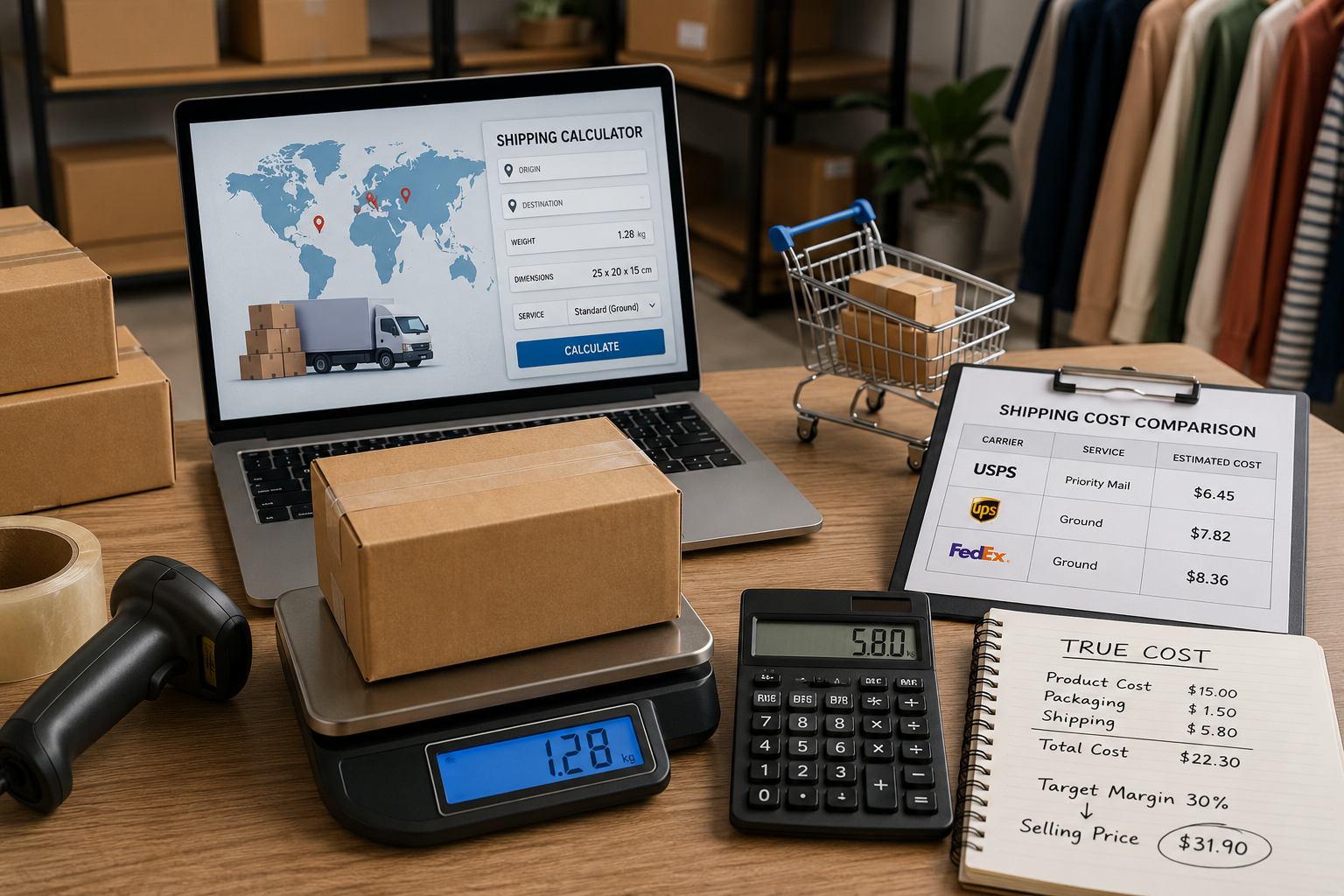
A shipping cost calculator does more than estimate a number – it changes how you make decisions. When you can see the real landed cost before booking, you negotiate better with suppliers, price products more accurately, and avoid margin erosion from defaulting to a single carrier without comparison.
Automated Label Printing and Tracking
Manual label creation is one of the highest-error-rate processes in small business fulfilment. A single address error can result in a returned shipment costing $15–30 in reship fees on a $25 product. Shipping automation platforms integrate directly with your store, generate accurate labels in seconds, and reduce address-related errors dramatically.
Shipping Analytics Tools
Most small businesses don’t know their true cost-per-shipment by carrier, zone, or product type. Shipping analytics tools surface this data and make it actionable. Common discoveries: one carrier consistently under-performing on delivery time, one product category generating disproportionate returns, or one geographic zone where express is being used when ground is adequate.
Reduce Returns to Save on Shipping Costs
Improve Product Descriptions
The leading cause of e-commerce returns is product mismatch – the item didn’t match expectations. Size, colour, material, and functionality descriptions that are precise and honest reduce “this isn’t what I thought” returns. Include dimensions, weight, and material composition for all physical products.
Use Better Product Images
Images set expectations. A product photographed in isolation gives customers less information than one photographed in use, at scale, from multiple angles. Higher-quality product images consistently reduce return rates.
Improve Packaging Protection
Damaged-in-transit returns are entirely a packaging problem. If a product category has a consistent damage return rate, the packaging is inadequate for the carrier handling it experiences. Document the damage pattern and redesign accordingly. The cost of better packaging is almost always lower than one damaged shipment plus reship.
Best Shipping Strategies for Different Small Businesses
Common Shipping Mistakes Small Businesses Should Avoid
- 📦 Ignoring Dimensional Weight: Using box sizes that are “close enough” without calculating DIM weight can add $2–5 per package. Audit your top 3 package sizes.
- 🔒 Using One Carrier for Everything: No single carrier is cheapest across all zones, weights, and service levels. Even a two-carrier strategy reliably lowers average shipping costs.
- 🆓 Offering Free Shipping Without Modelling the Cost: Free shipping is a competitive expectation, but the threshold and product mix determine whether it’s profitable or a margin drain. Model it before you launch.
- 🗂️ Not Tracking Shipping Performance: Businesses that don’t measure carrier performance, delivery times, and damage rates can’t optimise them. Even a monthly review reveals actionable patterns.
- 🤝 Never Asking Carriers for Better Rates: The default rate is the starting point, not the final price. Most small business owners have never asked about discount tiers – one conversation can reduce rates by 10–25%.
Future Trends in Small Business Shipping (2026)
- AI-driven logistics optimisation: AI-powered rate selection, dynamic carrier routing, and delivery time prediction are now accessible to small businesses through third-party platforms at affordable price points.
- Hyperlocal fulfillment centres: Dark stores and micro-warehouses in urban areas are enabling same-day delivery for small businesses by positioning inventory close to demand.
- Eco-friendly packaging: Sustainable packaging has reached price parity with conventional alternatives – and simultaneously reduces DIM weight exposure and resonates with customer values.
- Same-day delivery normalisation: Consumer expectation for same-day delivery is expanding beyond major metros. Regional fulfilment strategies are the infrastructure that makes this viable.
- Drone and automated delivery: Still in regulated rollout for most markets, but expanding in select metro and suburban corridors – worth monitoring as a future service level option.
Conclusion
The assumption that cheaper shipping means slower delivery is one of the most persistent – and damaging – beliefs in small business logistics. In practice, the businesses that ship fastest are often spending least per order, because they’ve invested in the right packaging sizes, carrier mix, fulfilment geography, and automation tools.
Start with the highest-impact lever in your current operation: if you haven’t audited your packaging for DIM weight, start there. If you’re using a single carrier for all shipments, run a comparison on your last month of orders. If you’ve never spoken to a carrier account representative about discount tiers, make that call this week.
Shipping strategy is not a one-time optimisation – it’s an ongoing operational practice. Review your carrier performance, cost-per-shipment, and packaging configuration at least quarterly.
Frequently Asked Questions
The cheapest shipping method depends on package weight, dimensions, and destination. USPS First-Class and Priority Mail are frequently most affordable for lightweight domestic packages under 1 lb. For heavier shipments, regional couriers or negotiated UPS and FedEx rates can undercut standard pricing significantly. There is no single cheapest option across all scenarios — which is why rate comparison before booking consistently produces lower aggregate shipping costs.
Small businesses can reduce shipping costs through packaging optimisation (eliminating DIM weight surcharges), negotiating volume-based carrier discounts, consolidating shipments where possible, using multi-carrier rate comparison platforms, and deploying shipping calculators to evaluate cost-per-package before dispatch. The highest-impact changes are packaging-related, as they apply savings to every single order immediately.
Yes – substantially. All major carriers use dimensional weight pricing, which calculates a billable weight based on package volume rather than actual weight. A large, lightly-packed box can cost significantly more to ship than a compact, snug-fitting one of identical actual weight. The formula is: length × width × height ÷ 139 (domestic US). If that figure exceeds actual weight, the carrier charges based on the higher number.
Shipping calculators give businesses the information they need to make better decisions before committing to a carrier or quoting a customer. A good calculator factors in actual weight, dimensional weight, carrier zone pricing, and available service levels – displaying the true landed cost per shipment. This enables accurate product pricing, carrier comparison on each order, and identification of the most cost-effective packaging configuration per product type.
How Inflation Is Changing Online Shopping Behavior Worldwide
Popular Right Now
Featured Calculators
Discount Calculator
Enter any original price and a discount percentage to instantly see your final price, exact savings, and whether the deal is genuinely worth it.
Deal Value Checker
Don't just see the % off — get a deal score from 1–10 and a clear verdict: Worth It, Average, or Bad Deal. Stop getting fooled by inflated "original" prices.
About Author

nazneen
Kitchen Chronicles
When it comes to everyday messes, you need a paper towel that’s strong, absorbent, and cost-effective.
Some of Our Top Posts



Populaar Tools

Selected For You
Related Posts
Start Saving Money
in Seconds
Join 10,000+ shoppers using Daily Discount Hub to spend less and live better.
Pick a tool and find out how much you can save right now. Make better spending decisions starting today.